 Lurgan Ju-Jitsu & Labyrinth BJJ
History of BJJ
- Feudal Japan: The roots of modern jiu-jitsu can be traced to the martial arts of feudal Japan, where samurai developed fighting techniques that relied on throws, locks, and chokes rather than strikes, which were less effective against opponents in armor.
- Jigoro Kano and Kodokan Judo: In 1882, master Jigoro Kano founded the Kodokan and created judo, a modernized martial art that incorporated the best techniques of traditional jujutsu schools. Kodokan judo also incorporated randori, or live sparring, to test techniques in real time.
- Mitsuyo Maeda travels the world: In 1904, Kano sent his student, Mitsuyo Maeda, to spread judo internationally. Maeda, who was an expert in ground fighting (newaza), traveled extensively, defeating opponents in various martial arts and refining his understanding of combat.
- Arrival in Brazil: Maeda arrived in Brazil in 1914. He met Gastão Gracie, a businessman who helped him establish a Japanese immigrant community. To show his gratitude, Maeda took Gastão's son, Carlos Gracie, on as a student.
- Carlos Gracie and his academy: After studying with Maeda and his assistants, Carlos Gracie opened the first Gracie Jiu-Jitsu academy in Rio de Janeiro in 1925. Carlos taught his brothers, including the younger and physically frailer Hélio, the techniques he had learned.
- Hélio Gracie adapts the art: Due to his smaller stature, Hélio struggled to perform many of the techniques he learned. He began modifying them to rely more on leverage and timing and less on strength, a key development that differentiated the style from its Japanese predecessors.
- The Gracie Challenge: To prove the effectiveness of their adapted style, the Gracies issued the "Gracie Challenge," public contests that pitted them and their students against practitioners of other martial arts in no-holds-barred matches. Their victories over larger opponents in boxing, judo, and wrestling built their reputation and attracted more students.
- Rival lineage: Though the Gracie family is most famous, another important lineage developed in parallel through Luiz França, another student of Maeda's. França's student Oswaldo Fadda and his academy demonstrated expertise in footlocks and challenged the Gracies, proving that mastery was not limited to just one family.
- Arrival in the U.S.: In the 1970s, Gracie family members began immigrating to the U.S. to spread BJJ. In 1978, Rorion Gracie arrived in Southern California and began teaching the art out of his garage.
- Birth of the UFC: In 1993, Rorion Gracie co-founded the Ultimate Fighting Championship (UFC), a martial arts tournament created to determine which fighting style was most effective in a real fight. Royce Gracie, Hélio's son, represented BJJ.
- Royce Gracie's dominance: A smaller and lighter fighter than most of his opponents, Royce used BJJ's ground fighting and submission techniques to shock the world and win multiple early UFC tournaments. His victories proved the effectiveness of BJJ and cemented its reputation as a premier martial art.
- BJJ becomes mainstream: The international exposure from the UFC caused an explosion in BJJ's popularity. The art became a foundational element of mixed martial arts (MMA) and grew into a global sport with its own competition circuit, overseen by organizations like the International Brazilian Jiu-Jitsu Federation (IBJJF).
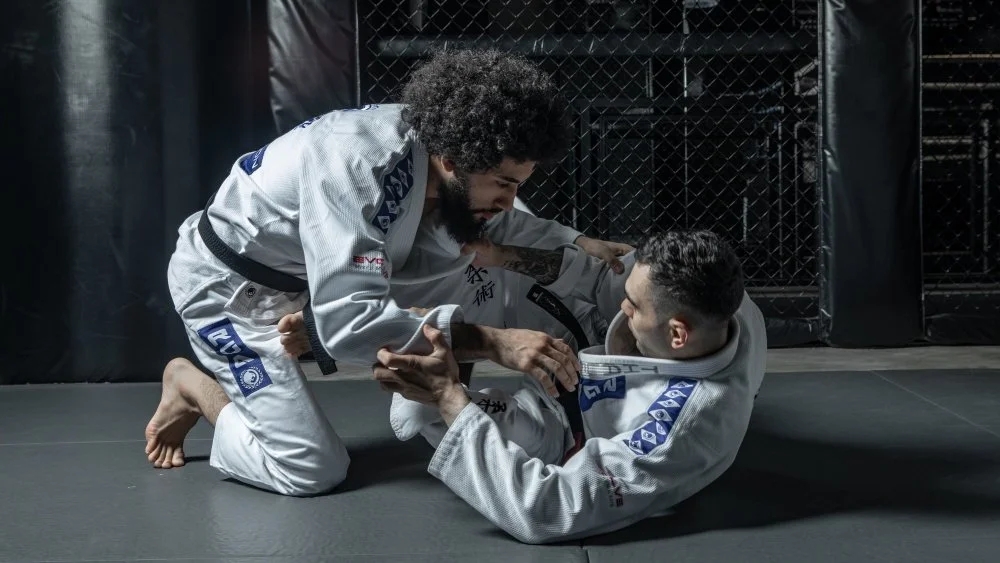
BJJ belts and promotions
Brazilian Jiu-Jitsu (BJJ) is a martial art that is known for its ranking system, which is represented by coloured belts. The belts in BJJ signify a student's level of proficiency and experience in the sport. In this blog post, we will be discussing how BJJ belts work.
Adult Belt Colours
BJJ belts come in various colours, and each colour represents a different level of skill. The traditional belt colours in BJJ are as follows:
White
Blue
Purple
Brown
Black
The progression from white to black belt signifies a student's growth and development in the sport.
Promotions
Promotions in BJJ are typically based on the student's ability to demonstrate their proficiency and knowledge of the sport. The instructor evaluates the student's progress and, when they feel the student is ready, promotes them to the next belt level.
Promotions are not given out easily in BJJ, and it can take years of consistent training and dedication to move up the ranks.
Stripes
Stripes are used to signify progress between belt levels. For example, a white belt may earn up to four stripes before being promoted to a blue belt. Stripes are typically given out for consistent training and improvement in technique.
The BJJ kids' belt system progresses from white to a series of coloured belts (grey, yellow, orange, and green) before moving to the adult system at age 16. Each colored belt has three stages: a white-striped belt, a solid belt, and a black-striped belt. Stripes are awarded to signify progress within a belt, with four stripes often leading to the next belt level.
- White belt: The starting point for all beginners.
- Grey belts: The first series of colored belts, typically for children aged 4-15.
- Grey/White belt
- Solid Grey belt
- Grey/Black belt
- Yellow belts: The next series of colored belts, for children aged 7-15.
- Yellow/White belt
- Solid Yellow belt
- Yellow/Black belt
- Orange belts: The next series of colored belts, for children aged 10-15.
- Orange/White belt
- Solid Orange belt
- Orange/Black belt
- Green belts: The final series of colored belts in the kids' system, for children aged 13-15.
- Green/White belt
- Solid Green belt
- Green/Black belt
- Adult belts: Once a student turns 16, they are eligible to test for the adult system, which begins with the blue belt.
- Stripes are awarded by instructors to show a child's progress and keep them motivated between belt promotions.
- A child typically earns stripes before advancing to the next belt.
- The number of stripes required for a promotion varies between academies, but four stripes is a common standard before a promotion to the next belt.